As heavy commercial vehicle fleets transition to electrification, passenger electric vehicle battery packs are also shifting from a 400V architecture to an 800V/1000V+ architecture, and traditional independent DC chargers are being rapidly phased out.
Commercial charging hub operators (CPOs), transportation hub and retail site developers are facing unprecedented demands for ultra-fast turnaround times, multi-connector versatility and uninterrupted uptime .
For international B2B distributors and contractors, procuring suitable high-power electric vehicle charging equipment is no longer just about buying “chargers”—it’s about investing in scalable, future-proof power infrastructure.
As a professional charging cube OEM and ODM manufacturer , we outline the core selection logic for high-power DC fast chargers (180kW to 480kW+) and explain why modular charging cube technology is setting the benchmark for commercial site deployments in 2026 and beyond.
1. How to choose a suitable high-power DC charger for a commercial hub
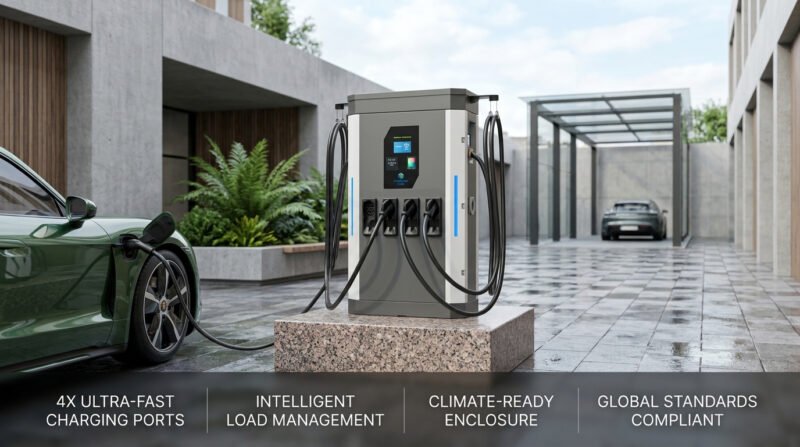
In the construction of electric vehicle charging stations, selecting charging pile power without analyzing vehicle dwell time, traffic flow, and grid availability is a major mistake. To maximize return on investment (ROI) and minimize losses from grid congestion, B2B procurement personnel should guide their clients to use the following strategic matrix:
| Site Overview | Recommended power rating | Target vehicle dwell time | Optimal charging hardware strategy |
| Urban retail and hotels | 120 kW – 180 kW | 25-40 minutes | Dual-gun dynamic load balancing; while utilizing standard 400A grid connection, it maximizes turnover rate. |
| Highway corridors and convoy hubs | 240 kW – 360 kW | 12-20 minutes | High-power dual or quad outputs; essential for long-haul electric vehicles and commercial delivery trucks. |
| Heavy trucks and megawatt-class wheels | 360 kW – 600 kW and above | 8-15 minutes | The liquid-cooled charging cube can provide up to 500A–800A of current per gun, enabling ultra-fast charging. |
The factory recommends prioritizing charging stations with a wide voltage output range (200V–1000V DC) for deployment in 2026 and beyond . This ensures seamless fast charging for standard 400V conventional electric vehicles and next-generation 800V high-voltage platforms (Porsche Taycan, Hyundai E-GMP, commercial electric buses).
2. Why the “Charging Cube” (Modular Power Stack) is the Ultimate Solution
For high-power charging stations, downtime directly leads to revenue loss. Traditional standalone charging piles have a high operational risk—if the internal inverter components fail, the entire unit will go offline.
Our charging cube architecture addresses this challenge with interchangeable power sub-unit matrices (e.g. , 30kW/40kW high-efficiency power modules).
Key advantages of the charging cube architecture in the B2B field:
N+X Redundancy Reliability (>99% Uptime): If an isolated module fails, the intelligent power matrix automatically isolates it and redistributes power to the remaining modules. The charger can continue to operate, preventing a site-wide downtime.
Pay-as-you-go scaling: On-site operators can install a 180kW cabinet with three 60kW module slots today, and upgrade to 240kW, 300kW, or 360kW in the future simply by inserting additional modules— without on-site civil engineering.
Dynamic matrix power sharing: Electricity is intelligently allocated according to the actual situation of the vehicles, prioritizing the most urgent power needs. For example, a 360kW charging module can dynamically provide 300kW of power to an 800V truck, while simultaneously providing 60kW of power to a passenger electric vehicle.
3. Basic Technical Standards for International Procurement
To avoid compliance hurdles and ensure smooth entry into the European, North American, Asia Pacific, and Middle Eastern markets, please ensure your OEM hardware meets the following key standards:
Unified multi-connector support: Native support for CCS1, CCS2, NACS (SAE J3400), and next-generation standards such as ChaoJi/CHadeMO 3.0 . Dual-connector configurations (e.g., CCS2 + NACS or CCS2 + CCS2) are crucial for regional compatibility.
OCPP 2.0.1 and ISO 15118 (Plug and Play): are essential for enabling seamless, cardless authorization, dynamic pricing, and advanced V2G (Vehicle to Grid) grid management.
High-current liquid cooling technology: Standard air-cooled cables become bulky and heavy when the continuous current exceeds 250A. Liquid-cooled dispensing guns, on the other hand, keep the cables lightweight and ergonomic, while still being able to handle continuous output currents of up to 500A or more.
Harsh environment enclosure (IP55 / IK10): Constructed with corrosion-resistant galvanized steel or aluminum enclosure, designed to withstand ambient operating temperatures from -30°C to +55°C.
4. Collaborate with direct OEM/ODM charging cube factories
In the highly competitive electric vehicle infrastructure sector, local distributors need more than just standard product resale—they also need customized solutions, regulatory support, and profit guarantees.
By working directly with our manufacturing facilities, global distributors can gain:
Customized OEM/ODM branding and enclosure design: Fully customized enclosure graphics, LED light strips, brand elements, and customized HMI touchscreen interface.
White-label backend integration: Hardware is pre-configured to automatically connect to your preferred CPO software platform via open APIs and OCPP compliance.
Factory direct sales profits and bidding support: competitive wholesale pricing model, comprehensive bidding support documents, compliance test reports (CE, UL, CB, TÜV) and direct factory engineering consulting.
Conclusion: Join us in creating the future of fast charging.
Commercial charging centers in 2026 will require flexibility, high efficiency, and uncompromising modular design.
By equipping your market with Charging-Cube high-power DC fast chargers , you can deliver long-term value, lower total cost of ownership (TCO), and greater uptime for your customers.